
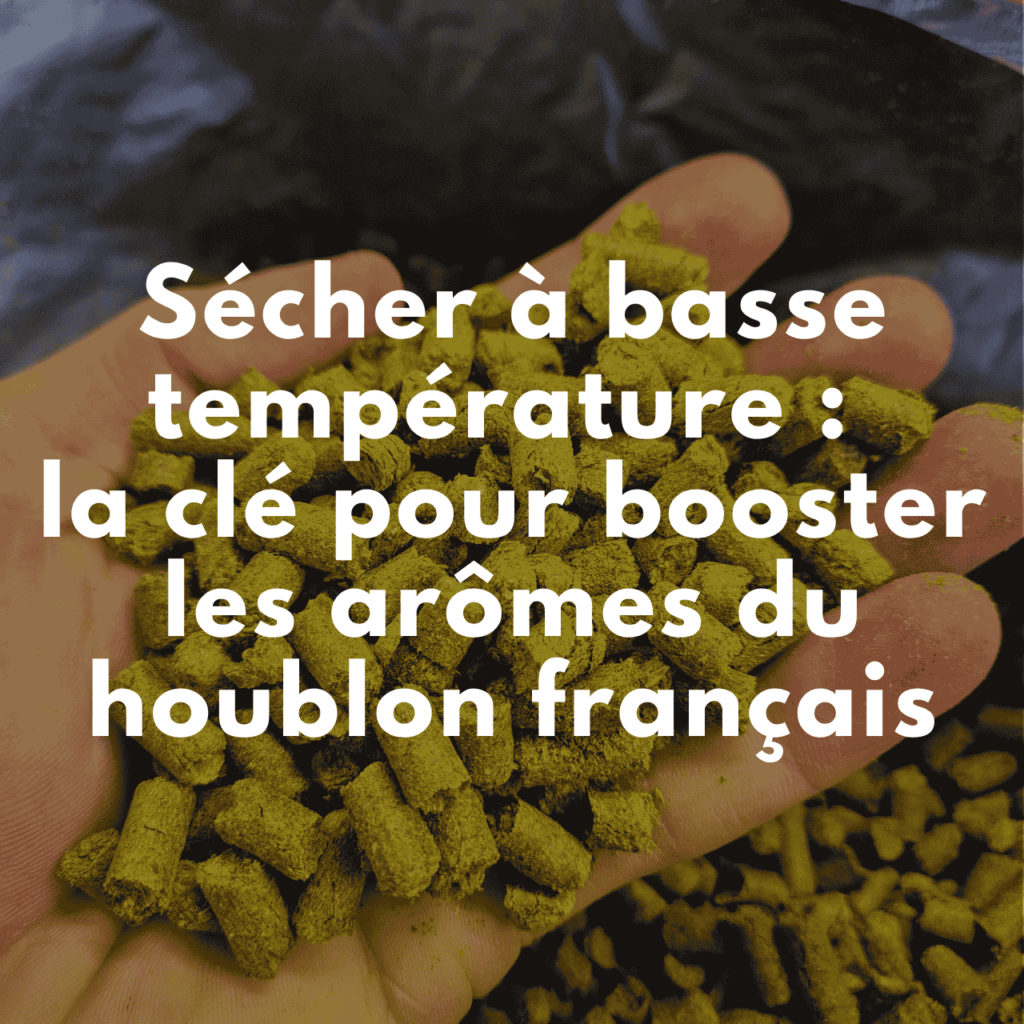
Why do French hops struggle to match the explosive aromas of American varieties? The answer may be hiding… in a low-tech dryer
For years, French brewers have faced a somewhat frustrating reality: French hops, though they have an excellent reputation for their noble varieties, struggle to compete with the fruity and resinous notes of US or New Zealand hops. Attempts have nevertheless been made since 2016-17 to grow American varieties (Cascade, Chinook...), but the aromatic results do not match those of their American counterparts. What if the solution lay not only in the varieties themselves, but in the way they are dried?
At HOPSTOCK, we ran a study over two harvests with Inagro, Brewing Theory and Twistaroma, which reveals some interesting findings about hop drying. At 45°C and with dehumidified air, the aromatic compounds of the hops are preserved, giving livelier and more complex aromas.
Why do US hops have such a good reputation?
First, two key factors need to be understood: the climate and traditional drying methods.
The Yakima Valley in the United States is known for its semi-desert climate. In September, relative humidity there is often below 30%. In France, by contrast, humidity regularly exceeds 60%, and even 90% during rainy spells. A cubic metre of air passing through the dryer is therefore up to 3x more effective there, which has a direct impact on hop drying.
In traditional dryers, humid air is heated so that it expands and absorbs the moisture from the hops more easily. The problem: this method exposes the cones to high temperatures (60-67°C) for a sometimes prolonged period (4 to 6 hours in the US, but up to 15 hours in France). The result? What has no consequence at all for a bittering hop (alpha acids are more resistant to high temperatures) has a direct and significant impact on the essential oils, which are responsible for the aromas and which degrade (oxidation and evaporation)
Traditional drying doesn’t just dry the hops… it also dries out their aromas.
The solution: low-temperature drying with dehumidification
In light of this, HOPSTOCK has developed an innovative yet fairly low-tech solution: a low-temperature dehumidification dryer. The principle? Reduce the hops’ exposure to heat and humidity in order to preserve their aromatic compounds.
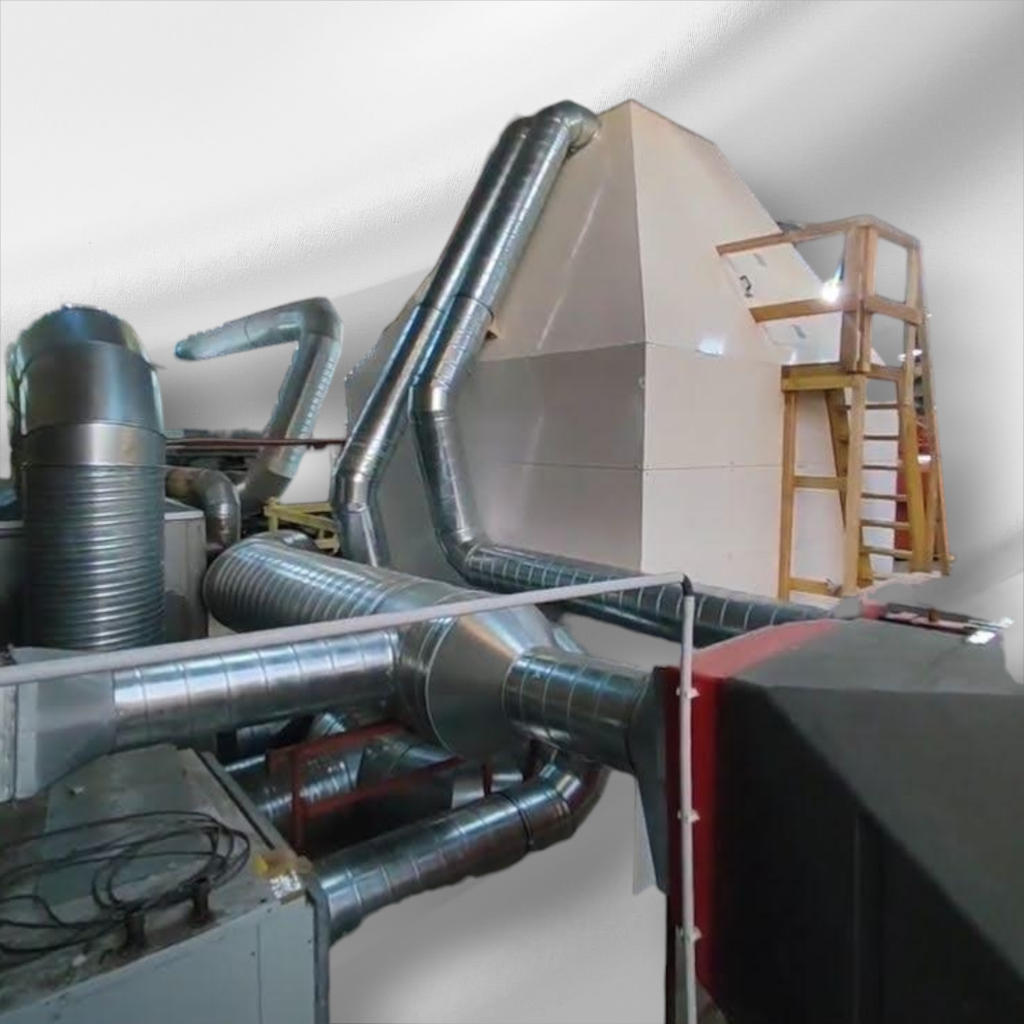
HOPSTOCK invested €200,000 of its own funds over a period of 5 years to design and build this prototype, which is both low-tech and quite innovative.
How does it work?
The HOPSTOCK prototype combines three key elements:
- A dehumidifier: to extract the moisture from the air before it passes through the hops.
- An air heat exchanger: to recover the heat without reintroducing the moisture.
- An oil-fired boiler: to heat the air to a temperature of 45°C.
The air is thus recycled in a closed circuit, reducing both energy consumption and the time the hops spend exposed to unfavourable conditions.
The benefits in figures:
- 28% more essential oils preserved compared with traditional drying. (HOPSTOCK data, INAGRO, 2023)
- 50% fuel oil saving, thanks to process optimisation. (HOPSTOCK data, 2023)
Focus on the preserved compounds:
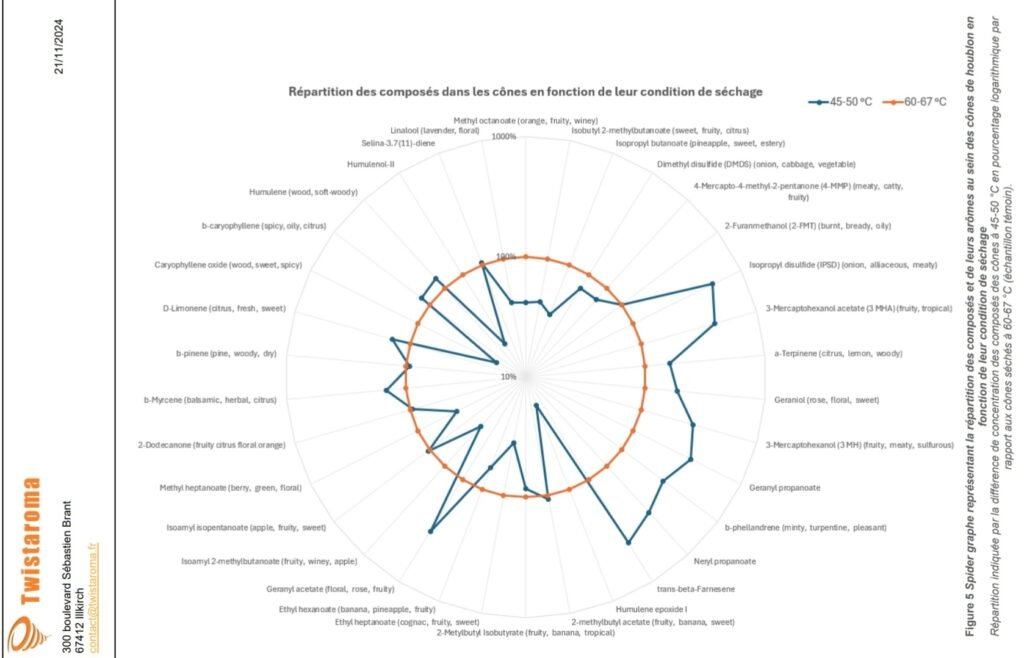
- Thiols: these ultra-powerful aromatic molecules (perception thresholds in ng/L) are responsible for exotic fruit notes such as mango or passion fruit juice. At 45°C, 3-mercaptohexanol acetate (3-MHA) is preserved at +331%, and 3-mercaptohexanol (3-MH) at +179%.
- Terpenes: these compounds bring floral, resinous and citrus aromas. Geraniol (rose/floral) is +85% more concentrated at low temperature, while humulene (woody) and caryophyllene (spicy) see their concentrations increase by 28% and 23% respectively.
Tangible results: 28% more oils, fruitier beers
Low-temperature drying has delivered encouraging results:
- +28% total oils preserved. These essential oils are the heart of hop aroma.
- 64% reduction in ester losses, including compounds such as isoamyl isobutyrate (banana and apricot notes) and ethyl hexanoate (pineapple and tropical fruit notes).
These significant gains make it possible to produce local hops capable of rivalling imported varieties on aroma, while meeting brewers’ requirements.
Testimonials
Testimonial from David Lutun, brewer and trainer at the Brasserie de Wagnonville, Lycée BIOTECH
I brewed a top-fermented batch with a fairly neutral yeast and a fairly low gravity (13°Plato), target 5.5% ABV.
I chose a so-called “smash” beer, i.e. a single malt (Pilsen 6rh) and organic Cascade from Houblon de la Motte (low-temperature drying and dehumidification) as bittering, aroma and dry hop additions (at the time I did not know how to extract essential oils); the aim was to bring out the aromatic potential of this Flemish Cascade alone. I used a standard dose without forcing it, around 600 g/hl dry hopping included (over a long period of 3 weeks).
The result was very good: rich, aromatic and powerful. Far more than what I was used to getting from the usual regional aroma hops.After a study trip to the Yakima Valley and taking part in a study programme on regional hops, Hauts-de-France sauvages, I was able to strengthen my conviction that, to optimise and recover the aromatic potential of all hops, they must be dried at a lower temperature and as quickly as possible.
The sample of organic Cascade from HOUBLON DE LA MOTTE and my trial convinced me that it is truly possible to draw a regional aromatic specificity from all the hops grown there. I think this will allow us to develop a strong and specific notion of terroir, and so to meet brewers’ desire to stand out through regional hops.
Conclusion of the analysis report “Hop cone analysis: drying at 45-50°C and 60-67°C” by TWISTAROMA in collaboration with Brewing Theory, 21 November 2024
[...]This study demonstrates the significant influence of drying temperature on the chemical composition and, consequently, on the aroma profile of hop cones. A lower drying temperature generally favours the preservation or enrichment of essential aroma compounds, such as certain thiols, terpenes and esters, which give beer fruity, floral and fresh notes.
The results highlight notable variations in concentration for key olfactory markers, such as 3-mercaptohexanol acetate (+331%) and isoamyl isobutyrate (+1277%) at low temperature [...].
These observations underline the complexity of the interactions between drying conditions and hop chemistry, with important implications for process management and the optimisation of aroma profiles in brewing production[...].
These results could guide drying practices to maximise the preservation of the most impactful compounds according to the sensory objectives sought, and provide a basis for exploring new drying strategies suited to the specific needs of brewers.
Implications for the French brewing industry: aromatic independence
Low-temperature drying paves the way for a reduced dependence on imports of US or New Zealand hops. By promoting French hops, brewers can lay claim to beers with a lower carbon footprint and a more local identity.
Sustainability
Beyond the aromatic gains, this drying method offers major environmental benefits:
- Lower energy consumption: Using a dehumidifier saves 50% of fuel oil compared with traditional drying.
- Reduced CO2 emissions: A choice aligned with the goals of the energy transition in agriculture.
Low-temperature drying changes the game for French hops. By preserving key compounds such as thiols and terpenes, this approach makes it possible to produce hops with more pronounced aromas, while cutting costs and environmental impact.
What next?
At HOPSTOCK, we will keep improving this dryer: installing better insulation, increasing the power of the dehumidifier, installing a biomass boiler and a rehumidification chamber, testing nitrogen drying (to reduce oxidation)...
Finally, to gather feedback from brewers, we are offering to send a free 500-gram sample of hops, organic Cascade, 2024 harvest, to anyone who wants one, in exchange for a testimonial (why not even a few beers to motivate the seasonal workers!)
If you are interested, send us an email at contact@brewstock.fr!
Houblon de la Motte, for BREWSTOCK
Brewstock.fr is a marketplace that allows brewers to source their hops from hop growers.